
15 Cozy Living Room Lighting Ideas for a Warm, Inviting Space
A living room can have the right sofa, a beautiful rug, and carefully chosen decor and still feel strangely uninviting once the sun goes down.
Very often, the problem is not the furniture.
It is the lighting.
One bright ceiling fixture may technically light the room, but it tends to illuminate everything at the same level. Cozy living rooms usually feel different because the light comes from several places and at different heights.
A lamp beside the sofa creates a small pool of light around the seating area. A lamp on a console softens the space behind the couch. A wall sconce can brighten a dark corner without taking up floor space. Accent lighting can draw attention to artwork, shelving, or architectural details instead of flooding the entire room.
The goal is not to make your living room brighter. It is to make the lighting more intentional.
These cozy living room lighting ideas show you where different lights work best, which common lighting mistakes make a room feel harsh, and how to create a warmer atmosphere without completely rewiring your home.
Before You Add More Lamps, Look at Where Your Light Is Coming From
Stand in your living room in the evening with the main ceiling light switched on.
Then look around the room.
Are the corners dark while the center is extremely bright?
Can you comfortably read on the sofa?
Does the television area have glare?
Is one side of the room noticeably darker?
Are all your lamps roughly the same height?
These questions tell you more than simply deciding that you “need more lighting.”
A comfortable living room usually benefits from a combination of:
Ambient lighting for general illumination.
Task lighting for reading or other activities.
Accent lighting for highlighting artwork, shelving, plants, or architectural details.
You do not need every possible type of fixture. You simply want enough variation that one overhead light is not responsible for the entire room.
1. Place a Floor Lamp Slightly Behind the Sofa
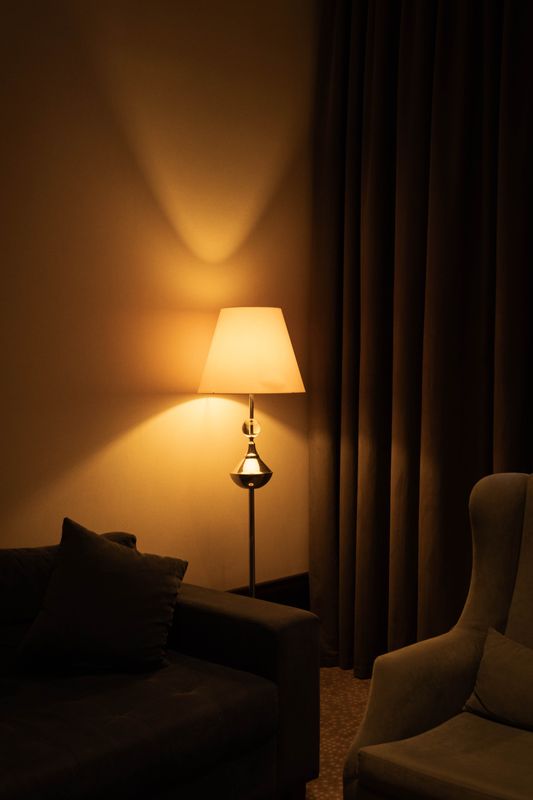
If your sofa sits in a darker part of the room, placing a floor lamp slightly behind one end can change the atmosphere almost immediately.
The position matters.
Instead of placing the lamp several feet away in an empty corner, bring it close enough that the light falls over the seating area. This creates a more intimate zone and gives you useful light for reading without illuminating the entire room.
A traditional shaded floor lamp works particularly well when you want soft, diffused light. If the room has low ceilings, a slimmer lamp with a simple shade can add height without making the corner feel crowded.
The lamp should feel connected to the furniture rather than floating by itself.
2. Use Three Light Sources Instead of One Bright Fixture
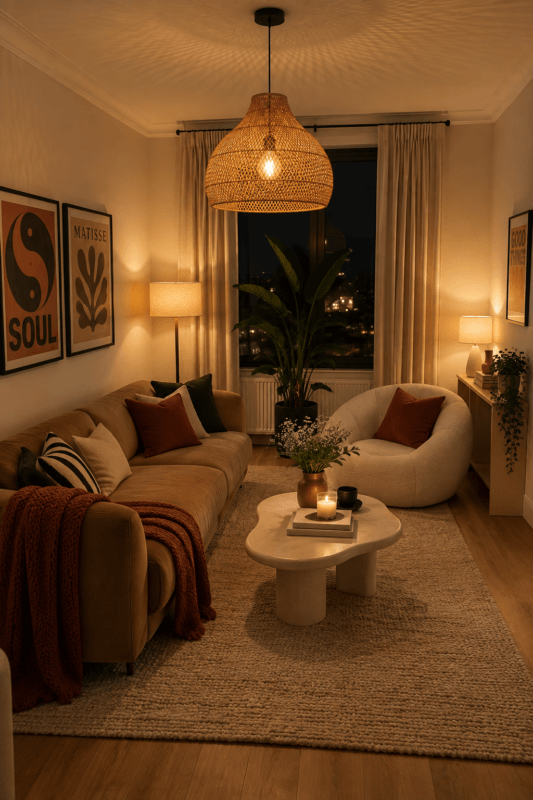
One of the easiest ways to create warm living room lighting is to spread the light around the room.
For example, you might use:
a floor lamp beside the sofa,
a table lamp on a console,
and a smaller lamp or sconce near an armchair.
The fixtures do not need to match.
In fact, varying their heights often creates a more natural result because your eye moves around the room instead of being drawn to a single bright point overhead.
The important thing is balance. If all three lamps are grouped on one side of the room, the opposite side can still feel unfinished.
Think about lighting the seating zones, not simply filling empty corners with lamps.
3. Add a Table Lamp to the Console Behind Your Sofa
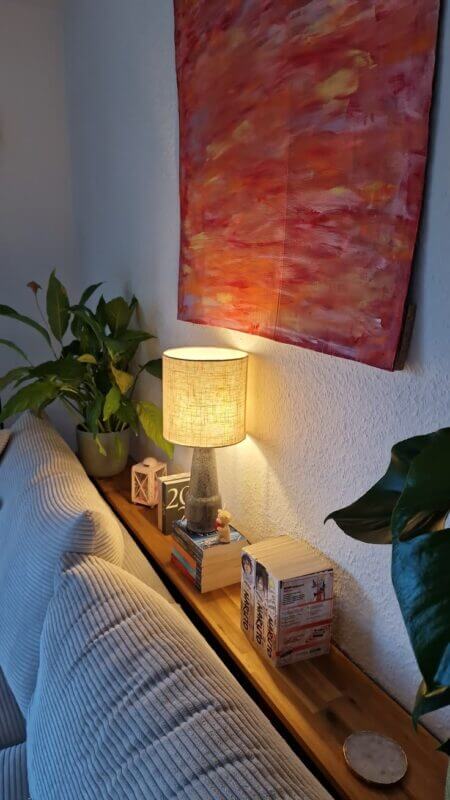
A console table behind a couch is one of the most useful places to introduce soft lighting.
A lamp here does two jobs.
First, it creates a glow behind the main seating area, which helps soften the contrast between a bright television and a dark room.
Second, the lamp becomes part of the console styling, adding height and helping anchor smaller objects such as books, bowls, frames, or decorative pieces.
If your sofa floats in an open-plan space, you can use two lamps for a more symmetrical arrangement. For a smaller console, one lamp balanced with artwork or a tall vase is usually enough.
If you are already working on this area, my guide to console table decor behind the couch has more ideas for combining lamps, storage, art, and decorative accessories without overcrowding the surface.
4. Switch to Warm White Bulbs
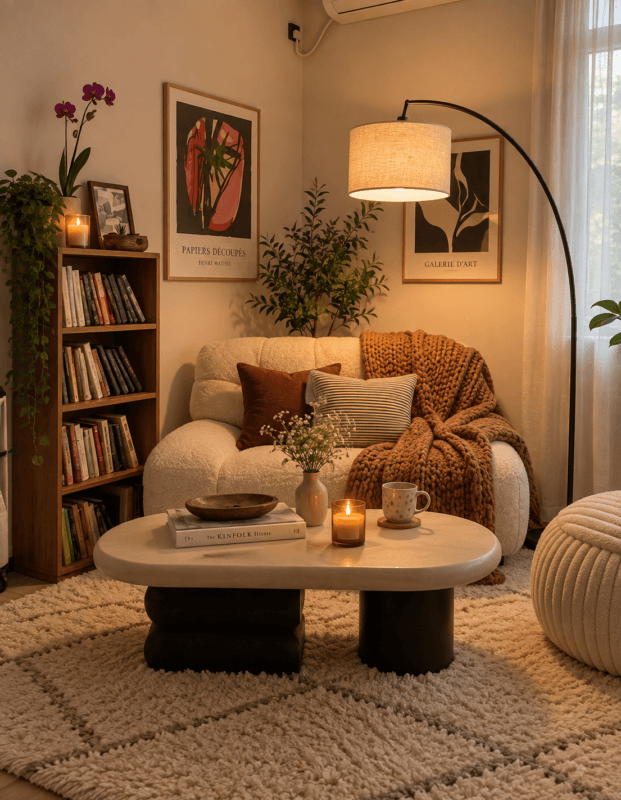
Sometimes the fixture itself is not the problem. The bulb is.
Very cool white light can make an otherwise warm living room feel clinical, especially in the evening.
For relaxing spaces such as living rooms and bedrooms, bulbs around 2700K to 3000K usually create a warmer appearance than cooler daylight-style bulbs.
You do not necessarily need the same exact bulb in every lamp, but try to keep nearby fixtures within a similar color range.
A warm table lamp beside a very cool ceiling light can make the mismatch surprisingly noticeable.
Also look at brightness.
A small decorative lamp does not need the same output as the lamp you use for reading. Matching brightness to the job of each fixture helps create layers instead of making every light compete for attention.
5. Create a Proper Reading Corner
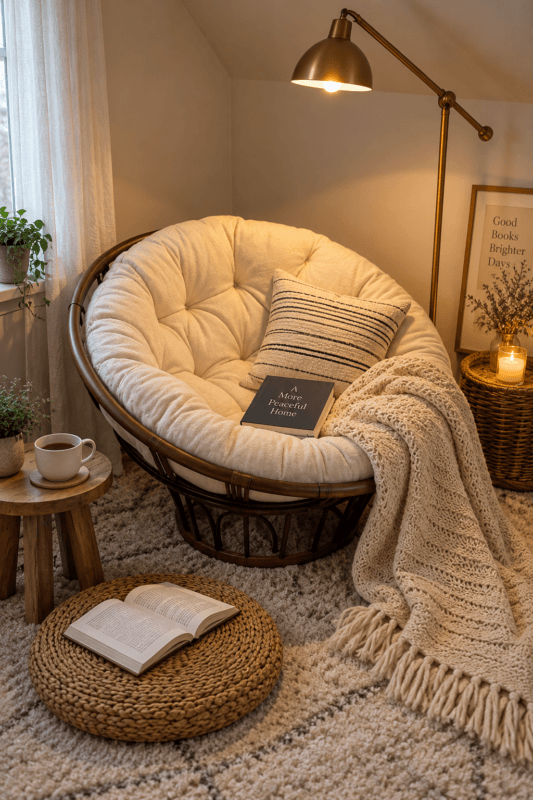
A chair and side table do not automatically make a comfortable reading nook.
The light needs to be positioned where it actually helps you read.
Place a floor lamp beside or slightly behind the chair so the light falls over your shoulder toward the book rather than directly into your eyes.
If you use a table lamp, check the height when you are seated. A lamp that looks perfectly proportional while standing may be too low to provide useful reading light.
This is especially important in a larger living room where one chair sits away from the main sofa.
Giving that chair its own light source makes it feel like an intentional part of the room instead of spare seating placed in a corner.
6. Use Plug-In Wall Sconces When Floor Space Is Limited
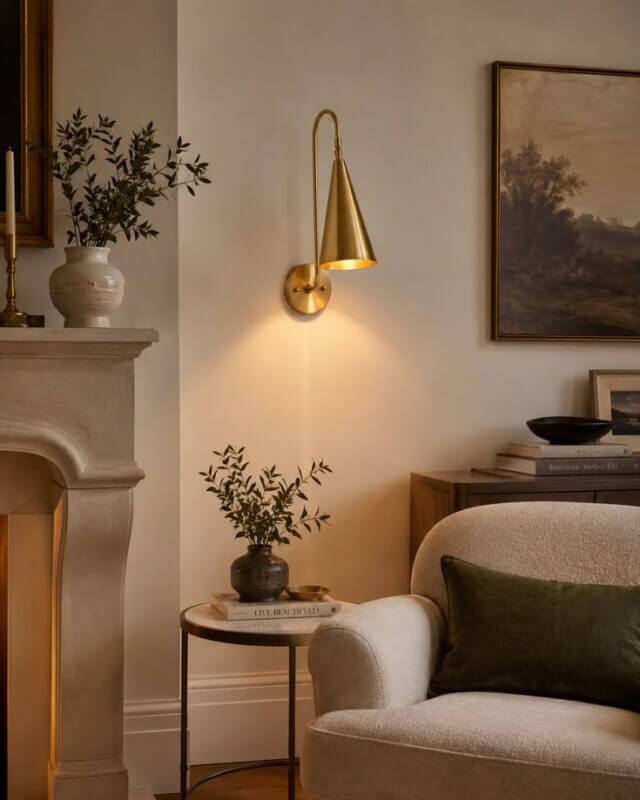
Small living rooms do not always have room for another side table or floor lamp.
Plug-in wall sconces solve that problem without requiring permanent electrical work.
They can work beside a sofa, above a compact reading chair, or on either side of built-in shelving.
Swing-arm sconces are especially practical because you can direct the light when reading and move them back when they are not needed.
This is also a useful strategy in a narrow living room, where preserving the walkway matters more than adding another piece of furniture.
Choose sconces with cords that can be routed neatly along the wall. Visible tangled cables can make an otherwise thoughtful lighting arrangement look unfinished.
7. Use an Arc Floor Lamp Over a Sectional
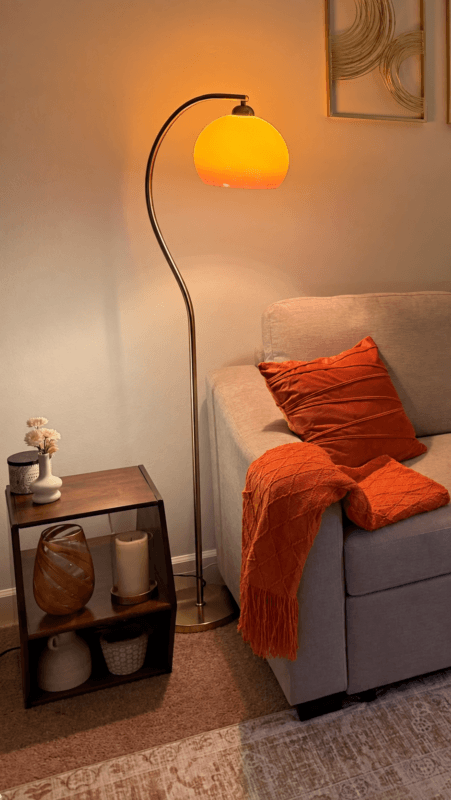
A large sectional often creates a different lighting problem.
The middle seats can be too far from side tables for a traditional table lamp, while a standard floor lamp may only illuminate one end.
An arc floor lamp can reach farther over the seating area.
Position the heavy base beside or behind the sectional and allow the arm to extend toward the area where you actually need the light.
Before buying one, measure carefully.
An arc lamp that is too low can feel intrusive above the sofa, while one that extends too far may interfere with people walking through the room.
This lighting idea works best when the lamp has enough surrounding space to look intentional rather than squeezed between furniture.
8. Put a Small Lamp on a Bookshelf
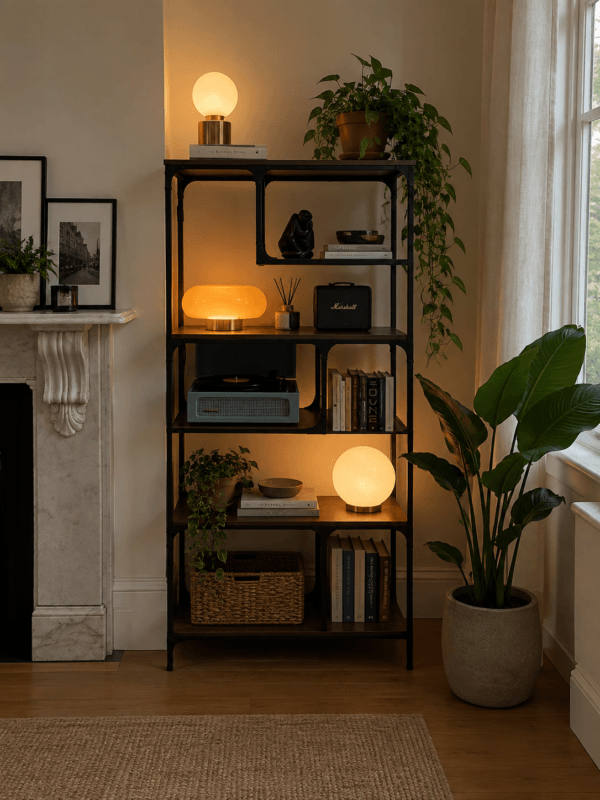
Not every lamp has to sit beside a sofa.
A small accent lamp placed on a bookshelf can make an entire wall feel warmer in the evening.
The key is scale.
Choose something compact enough that it leaves breathing room around the surrounding books and decor. A large lampshade stuffed between shelves will make the display look crowded.
A bookshelf lamp works especially well when the shelving sits opposite or adjacent to the main seating area.
Instead of looking across the room at a dark wall, you get a softer visual focal point.
This is a good place for a rechargeable lamp if there is no convenient outlet nearby.
9. Add Soft Lighting Around the TV Instead of Above It
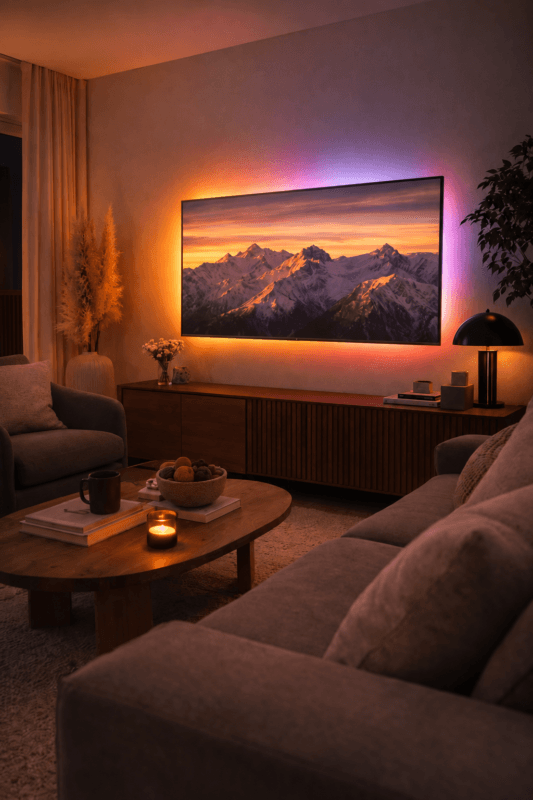
The wall around a television can be tricky.
A bright ceiling fixture reflected in the screen creates glare, while placing strong spotlights directly above the TV can make the wall feel harsher.
Instead, consider softer light beside or behind the television area.
A table lamp on a nearby console, subtle shelf lighting, or a low-output light behind the TV can reduce the dramatic contrast between a bright screen and a completely dark room.
Do not point lamps directly at the screen.
The goal is gentle background illumination, not another competing focal point.
If your television wall already feels unfinished during the day, combine the lighting with some of the ideas from our TV wall decor ideas so the area works both when the television is on and when it is off.
10. Light Artwork From the Side, Not Just From the Ceiling
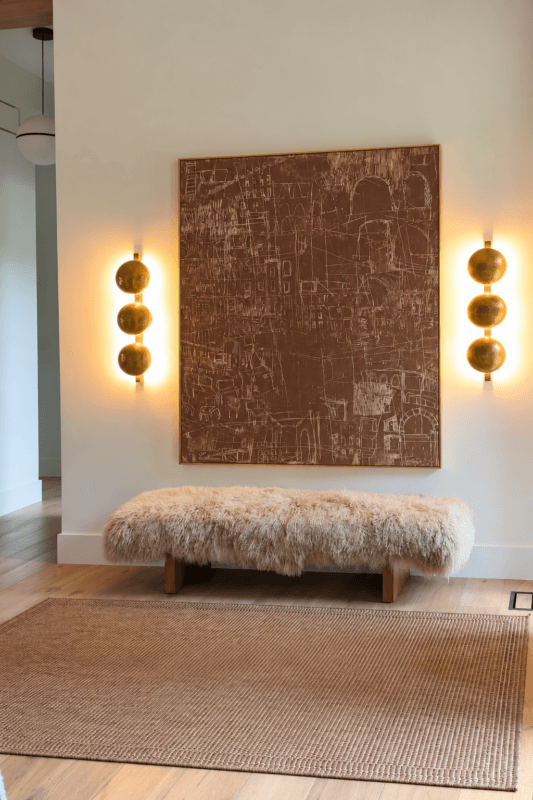
Artwork often disappears once evening arrives.
Instead of increasing the brightness of the entire room, give important pieces their own nearby light source.
A lamp positioned below and slightly to one side can draw attention to artwork without making it look like a gallery display.
Picture lights are another option, particularly over one large piece of art.
Just avoid trying to illuminate every frame on a gallery wall individually. Too many tiny light sources can make the wall visually busy.
Choose the artwork or feature you want to emphasize and let the surrounding pieces sit more quietly.
Accent lighting works best when it creates hierarchy.
11. Use Lamps to Define an Open-Plan Living Room
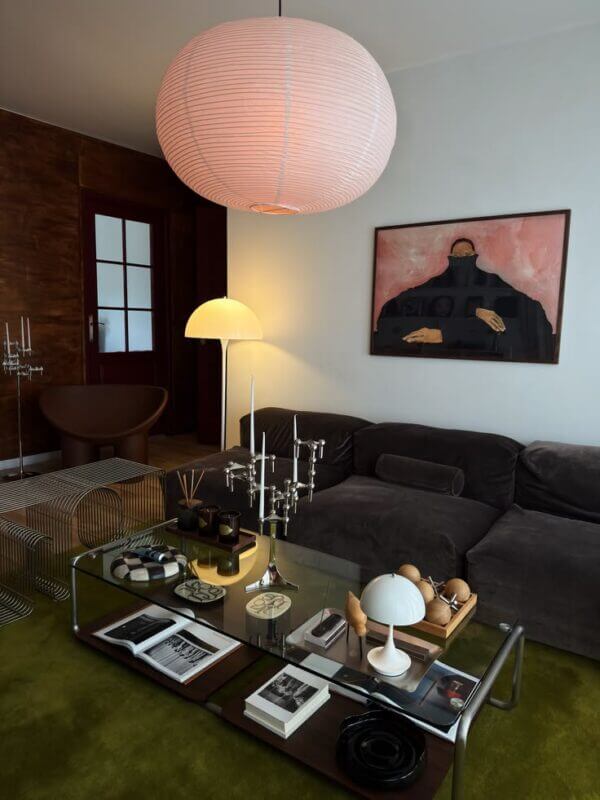
Open-plan rooms often feel difficult to light because one large ceiling fixture is expected to serve the living room, dining space, and walkway at the same time.
Instead, treat each functional area as its own lighting zone.
The living room might have a floor lamp and console lamp.
The dining space can have its own pendant or chandelier.
A nearby entry or hallway can have a smaller lamp or wall light.
Once the zones are lit independently, the space feels more organized.
This approach also allows you to turn off the brighter fixtures when you are relaxing in the living room.
For another example of how small pools of warm light can create a more welcoming transition into a home, see our cozy entryway ideas.
12. Try a Rechargeable Lamp Where There Is No Outlet
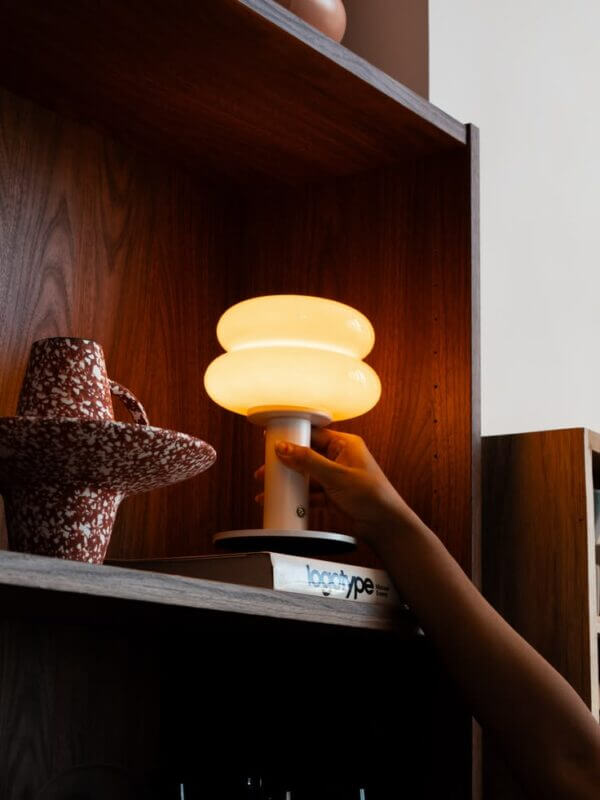
Sometimes the best place for a lamp is exactly where there is no plug.
This often happens with:
floating furniture,
bookshelves,
small side tables,
console tables,
and corners far from the wall.
Rechargeable lamps are useful because you can place the light where the room actually needs it rather than arranging furniture around an outlet.
They are particularly effective as accent lighting.
Use one on a shelf, side table, or small console rather than expecting a tiny rechargeable lamp to illuminate an entire living room.
It is also worth checking how the lamp looks when it is switched off. Because these fixtures are often small and visible, they should still work as part of the room’s decor during the day.
13. Put Your Main Lamps on Dimmers or Use Dimmable Bulbs
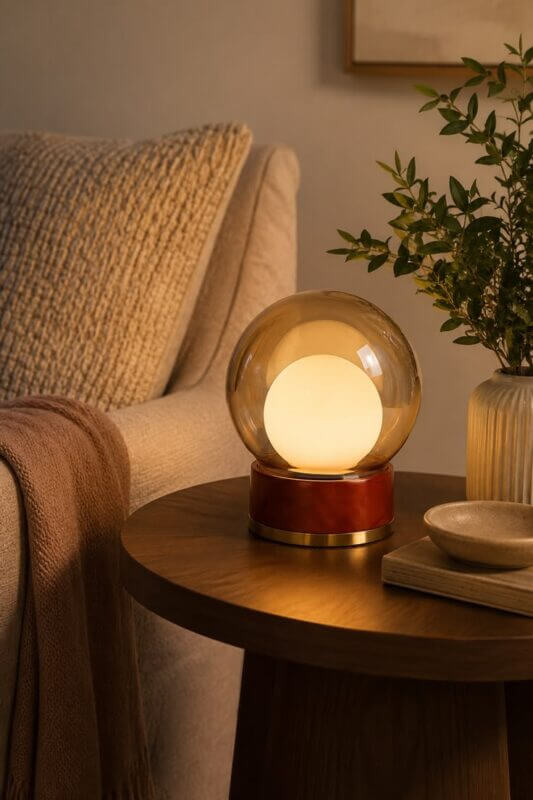
Your living room does not need the same amount of light at 3 p.m. and 9 p.m.
Dimming gives you flexibility.
Brighter light can be useful when cleaning, working, or hosting.
Lower light is usually more comfortable when watching television, talking, or winding down in the evening.
If your existing wall switches cannot accommodate a dimmer, smart bulbs and some plug-in lamps offer another option.
The important thing is not the technology.
It is having control over intensity.
A room feels far more intentional when you can adjust its lighting to suit what you are actually doing rather than choosing between “fully on” and “completely dark.”
14. Choose Lamp Sizes That Match Your Furniture
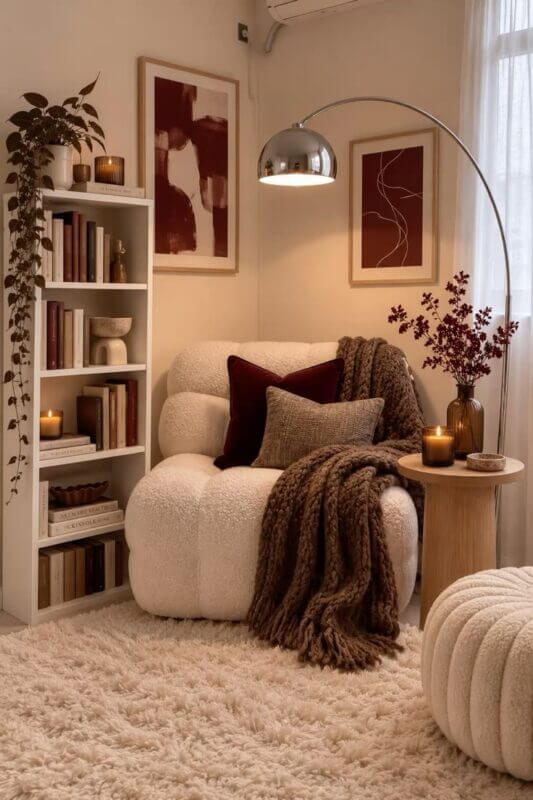
A beautiful lamp can still look wrong if the proportions are off.
A tiny lamp on a large side table often looks lost.
An oversized lamp on a narrow table may dominate the entire seating area.
Look at the lamp and table as one composition.
The shade should not overwhelm the tabletop, and the lamp should feel substantial enough to relate to the sofa or chair beside it.
The same principle applies to console tables.
If the console is long, one very small lamp at one end may not provide enough visual balance. You might need a larger lamp, a pair of lamps, or another tall object on the opposite side.
This is where lighting and decorating overlap. The fixture needs to work both when it is illuminated and when it is simply part of the room.
15. Stop Treating the Ceiling Light as the Main Event
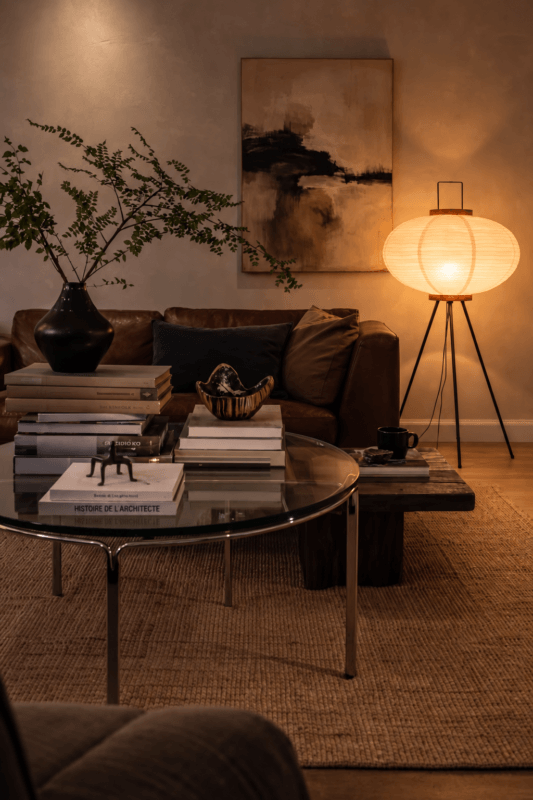
The biggest shift you can make is surprisingly simple:
Stop switching on the overhead fixture automatically every evening.
Try turning on only your lamps first.
Use the ceiling light when you genuinely need stronger general illumination, but allow the floor lamps, table lamps, sconces, and accent lights to create the atmosphere.
You may find that the room feels warmer even though there is technically less light.
That is because cozy lighting is not about maximum brightness.
It is about placing the right amount of light where people sit, read, talk, and relax.
Common Living Room Lighting Mistakes to Avoid
Using only one light source
A single bright fixture often leaves you choosing between a room that feels too bright and one that feels too dark.
Add at least one secondary source near the seating area before assuming you need a stronger ceiling bulb.
Putting lamps where they look good but do not function
A lamp hidden in an unused corner may look attractive in photographs but provide little useful light.
Start with where people actually sit.
Choosing every fixture at the same height
Variation creates depth.
Mix lower table lamps with taller floor lamps and, where appropriate, wall lighting.
Using extremely cool bulbs in a warm interior
Warm wood, beige upholstery, cream walls, and soft textiles can look very different under harsh cool-white lighting.
Check your bulb temperature before replacing furniture or changing paint colors.
Ignoring glare
Sit in your usual position and look toward the television, windows, mirrors, and framed glass.
If you can see the bulb reflected directly back at you, adjust the angle or position of the fixture.
Overfilling the room with decorative lamps
Layered lighting does not mean putting a lamp on every available surface.
Every fixture should have a job.
FAQ
How Many Lamps Does a Living Room Need?
There is no correct number because room size and layout matter more than a formula.
A small living room may work beautifully with one floor lamp and one table lamp.
A larger room with several seating zones might need four or more light sources.
Instead of counting fixtures, ask whether the room has enough light for its main activities.
Can you read comfortably?
Does the sofa area feel inviting?
Are important corners completely dark?
Can you watch television without harsh glare?
Can you reduce the lighting in the evening without making the room unusable?
If the answer to those questions is yes, you probably have enough.
What Is the Best Lighting for a Cozy Living Room?
A combination of warm ambient light, focused task lighting, and a small amount of accent lighting usually creates the most comfortable result.
Start with the places where people spend the most time.
Light the sofa.
Light the reading chair.
Add a soft source behind or beside the main seating area.
Then look at what remains dark.
This method is much more effective than buying several lamps first and trying to find places for them afterward.
Can You Make a Living Room Cozy Without Changing the Ceiling Fixture?
Absolutely.
In many rooms, the ceiling light becomes far less important once you add well-placed lamps.
Start with a floor lamp beside the sofa and a table lamp across the room.
If you still have dark areas, add another targeted source such as a wall sconce, bookshelf lamp, or rechargeable accent lamp.
This is particularly useful for renters because you can dramatically change how the room feels without replacing permanent fixtures.
Final Thoughts
The best cozy living room lighting ideas aren’t necessarily the most expensive or dramatic.
They are the ones that solve a specific problem.
A dark sofa corner needs a nearby floor lamp.
A floating couch can benefit from a lamp on the console behind it.
A reading chair needs directional task lighting.
A small living room may need wall-mounted lighting instead of another piece of furniture.
And a room that feels harsh at night may need warmer bulbs and less reliance on the ceiling fixture.
Before buying anything new, spend one evening paying attention to how you actually use your living room.
Turn off the main light.
Switch on the lamps you already own.
Move one closer to the sofa.
Try another on a console or shelf.
Sometimes the difference between a living room that merely looks decorated and one that genuinely feels comfortable is simply putting the light in the right place.